
MCTC State Release Paths
Marion Correctional Treatment Center belongs to the Virginia Department of Corrections. It serves a state correctional treatment role inside Smyth County, but location does not make it a Smyth jail. A prisoner leaving MCTC may transfer to another VADOC institution, leave prison on parole or probation, or complete the state term and discharge. Each path creates a different status and record.
A transfer keeps the person in state custody. Release to community supervision ends physical incarceration while VADOC authority continues through a district office. Final discharge ends the applicable correctional or supervision term. A court order and time computation may explain why a date was expected, but the VADOC facility-release documents show the actual step taken.
| MCTC event | Where to confirm it |
|---|---|
| Transfer within VADOC | VADOC locator and institutional record |
| Release to parole or probation | Signed conditions, locator, and District 17 |
| Sentence discharge | Notification-of-release letter and discharge record |
| Later historical inquiry | Inactive-record request or the sentencing court file |
Confirm an MCTC Release
Start with the VADOC Inmate & Supervisee Locator. It covers people in state custody or supervision, including prisoners, probationers, parolees, qualifying local-jail prisoners under VADOC authority, and some other state placements. It is not a permanent name index of every fully discharged person.
The official VADOC facilities directory places MCTC in the correct state system.
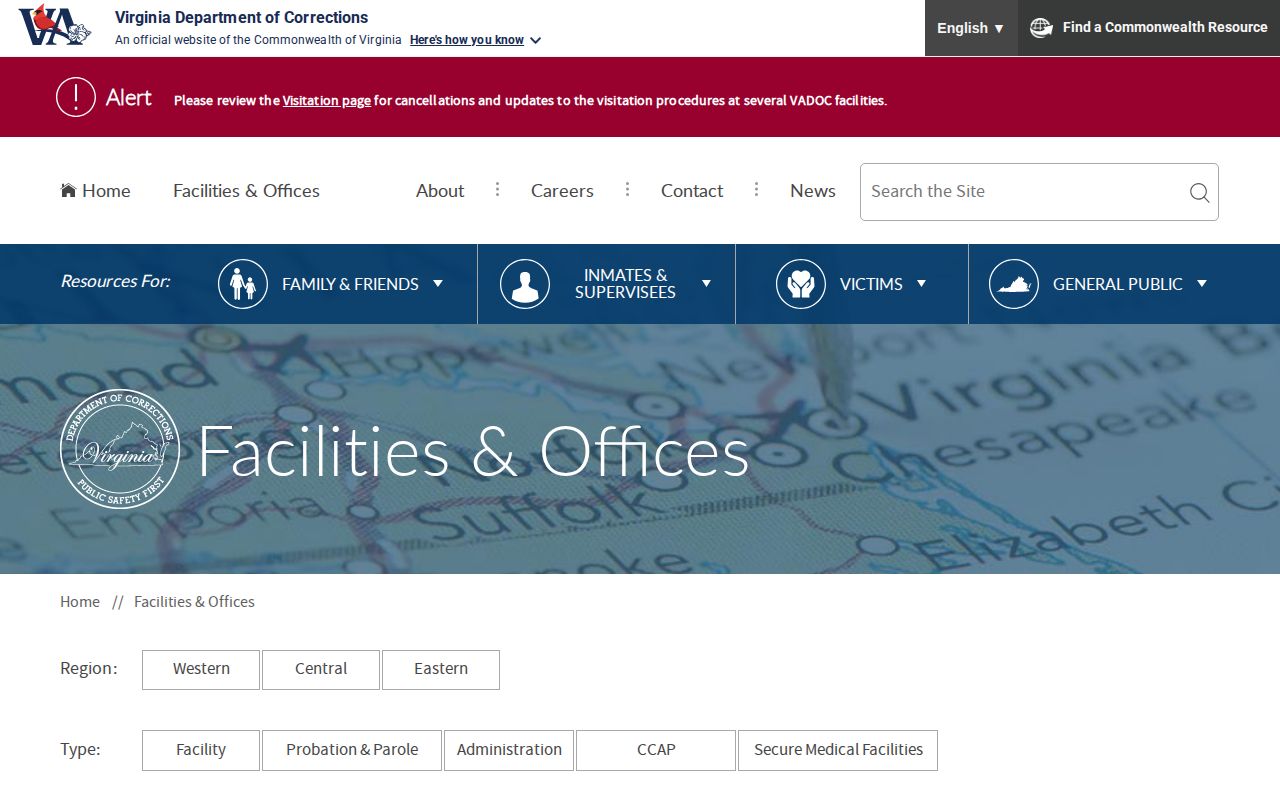
This directory view helps separate MCTC from the SWVRJA regional-jail route used for local Smyth custody.
The locator accepts the first three characters of the first name plus the full surname, or a seven-digit DOC ID. Optional filters include location, race, gender, and age. VADOC says data updates daily but warns that it may be inaccurate or outdated. No result does not prove an MCTC release.
- Search by the required name form or DOC ID and complete the disclaimer and CAPTCHA.
- Read whether the result shows institutional custody or community supervision, and verify the listed location.
- For an actual release, request the notification-of-release letter and signed release, probation, or parole document.
- Contact District 17 when the locator shows community supervision tied to Smyth County.
- After final discharge, use the correct inactive-record or FOIA process and check the sentencing court.
The Smyth County release search can help when it is unclear whether the person was in the local regional jail or VADOC custody.
MCTC Release Records Contact
Person-specific VADOC records ordinarily route to the facility warden or unit manager, or to the probation and parole chief who maintains the community record. A narrow request should identify the person and seek an existing release order, actual release-date field, notification letter, or discharge document. Whole correctional files contain restricted material, so targeted wording can reduce delay and unnecessary redaction.
Marion Correctional Treatment Center
Virginia Department of Corrections
110 Wright Street
Marion, VA 24354
VADOC FOIA Office
P.O. Box 26963
Richmond, VA 23261
804-963-2953
FOIA@vadoc.virginia.gov
A former inmate or former CCAP probationer or parolee seeking their own inactive record follows VADOC Operating Procedure 050.6 and submits notarized Form 050_F17. That is a personal-access route, not a public lookup. A third-party request proceeds under Virginia FOIA and applicable exemptions. The court judgment remains a separate historical source.
Virginia FOIA generally requires an initial response within five working days, but the response may produce records, cite withholding grounds, provide redacted records, state that records cannot be found, or invoke the allowed extension. The agency need not create a new record.
MCTC Treatment Facility Role
MCTC is a state correctional mental-health treatment facility. Its treatment mission does not change the records boundary: VADOC, not SWVRJA or the Smyth Sheriff, is the custodian for the prison release and state supervision path. Medical and mental-health material may also face specific disclosure limits that do not apply to a basic public locator result.
A VADOC release packet can include a notification-of-release letter and, as applicable, an Order of Release, Conditions of Probation, or Conditions of Parole. The person reads or receives the terms, signs them, and staff witness and date the documents. VADOC says discharge or parole releases occur by the end of the release date, weather permitting. Those signed records establish an event that a projected date only forecasts.
- Discharge
- Completion of the applicable correctional or supervision term.
- Parole
- Conditional prison release for a person eligible under Virginia law.
- Probation
- Court-ordered community supervision that may follow a suspended sentence.
- Transfer
- Movement to another custodian, not release into the community.
Note: A person can be out of MCTC while still appearing in the VADOC locator as a community supervisee.
MCTC History and Accreditation
Marion Correctional Treatment Center has a distinct history within Smyth County. The site began as a state mental hospital in 1958. Corrections acquired it in 1980, and it then opened in its correctional treatment role. That history explains both the facility name and its specialized mission, but it is not evidence about any named prisoner's custody status.
VADOC reported a three-year Department of Behavioral Health and Developmental Services license in May 2025. By January 2026, its MCTC accreditation announcement described the prison as VADOC's first facility to hold both Joint Commission accreditation and DBHDS licensure. These milestones relate to organizational standards and care. They do not change the VADOC locator, release paperwork, or inactive-record route.
In October 2025, VADOC also announced the SafeAides “Walk, Talk, and Refer” program at MCTC. SafeAides gives trained peers a role in identifying concerns and connecting people to help. It should not be described as a general release office, discharge database, or guarantee about post-release services.
MCTC Projected Versus Actual Release
Time computation and release proof answer different questions. A projected date is the current forecast based on sentence data, prior jail credit, applicable credit rules, classification, discipline, and later court or data changes. VADOC customer-service staff may confirm a projected date at the time of inquiry, but the public locator's exact date label must be read from the live result rather than assumed.
An actual MCTC release is documented later. The notification letter and signed, witnessed release or supervision terms show that physical custody ended or changed. If the person then reports to District 17, the locator may still show VADOC supervision. When all supervision ends, a public result may no longer remain available and an inactive record becomes the historical route.
| Record | Question answered |
|---|---|
| Projected date | When release is now expected |
| Final computation | How the term and credits were applied |
| Signed release packet | What status followed physical release |
| Inactive record | What remains after final discharge |
MCTC Post-Release Supervision
District 17 serves Bristol and Russell, Smyth, and Washington counties from Abingdon. When an MCTC prisoner leaves on parole or probation and lives in this service area, the district may become the verification office. Its role begins after institutional custody changes. It does not operate MCTC and cannot turn a projected date into proof of release.
Read the signed conditions and locator result together. The document states the legal terms, while the current locator may identify supervision status. Individual reporting instructions control. Statewide descriptions of intensive, medium, or low supervision are not a promise of the same schedule for every person.
If the person is fully discharged, District 17 may no longer be the active office. Route a historical request to the record custodian and use the final court and release documents instead. This preserves the line between present supervision and past state custody.
A person-specific MCTC inquiry should also preserve the DOC identification number, full name, sentencing court, and approximate date range when known. Those details help distinguish the prison stay from an earlier SWVRJA booking or a later district record. Ask the institution for the release packet, the district for its supervision record, and the court for the sentencing order. Combining the three does not make restricted treatment information public. It simply assigns each fact to the source that maintains it.
When dates conflict, the signed and witnessed facility document is stronger proof of the physical event than a projection or an old locator capture. A later locator observation can still show that VADOC supervision continued. Record when each source was checked, because an active status can lawfully change after the observation.