
District 17 Supervision Status
District 17 administers state probation and parole in Bristol and Russell, Smyth, and Washington counties. Its office verifies a post-prison or court-ordered VADOC supervision relationship. Physical release takes place at a jail or VADOC facility; District 17 then manages a qualifying person in the community. That distinction is vital when a searcher sees a VADOC locator result after incarceration has ended.
A parolee has left prison conditionally under an eligible Virginia sentence. A probationer is under court-ordered supervision, often tied to a suspended term. Both may have signed conditions and an assigned officer, but the source of authority differs. Final discharge ends the active supervision term. Until then, “released from prison” does not mean “off correctional supervision.”
| Status | Meaning | Primary proof |
|---|---|---|
| Parole | Conditional release from an eligible prison term | Parole conditions and VADOC record |
| Probation | Court-ordered community supervision | Sentencing order and probation conditions |
| Final discharge | Active VADOC supervision has ended | Discharge record or inactive file |
| Local pretrial supervision | Separate court-directed local program | Court order and Community Corrections |
Confirm District 17 Supervision
The VADOC Inmate & Supervisee Locator is the first public check. It covers current custody and supervision, not every former state prisoner after discharge. Search using at least the first three characters of the first name and full surname, or a seven-digit DOC ID. Location, race, gender, and age are optional filters.
- Search the VADOC locator and complete its disclaimer and CAPTCHA.
- Read whether the matching record indicates institutional custody or community supervision.
- Compare the result with the release packet, conditions, and sentencing or parole order.
- Use the VADOC facilities directory to identify District 17 as the Smyth service office.
- Call the district when a current result is stale or unclear, while respecting disclosure limits.
VADOC states that its locator updates daily but warns that information may be inaccurate or outdated. A missing result can reflect spelling, final discharge, another custody system, or a record limit. It does not prove that a person never had supervision. The Smyth County release-record search provides the parallel jail and court routes when the custody type is uncertain.
District 17 Records Contact
The Abingdon office is the published state supervision contact for Smyth County. The VADOC facilities and offices directory is the official source to recheck before a visit. The county directory also lists a Smyth suboffice phone, but no current address or walk-in instructions were established for that suboffice. Confirm directions rather than assuming the county phone identifies a public counter.
The captured VADOC directory shows the official statewide office channel used to locate District 17.
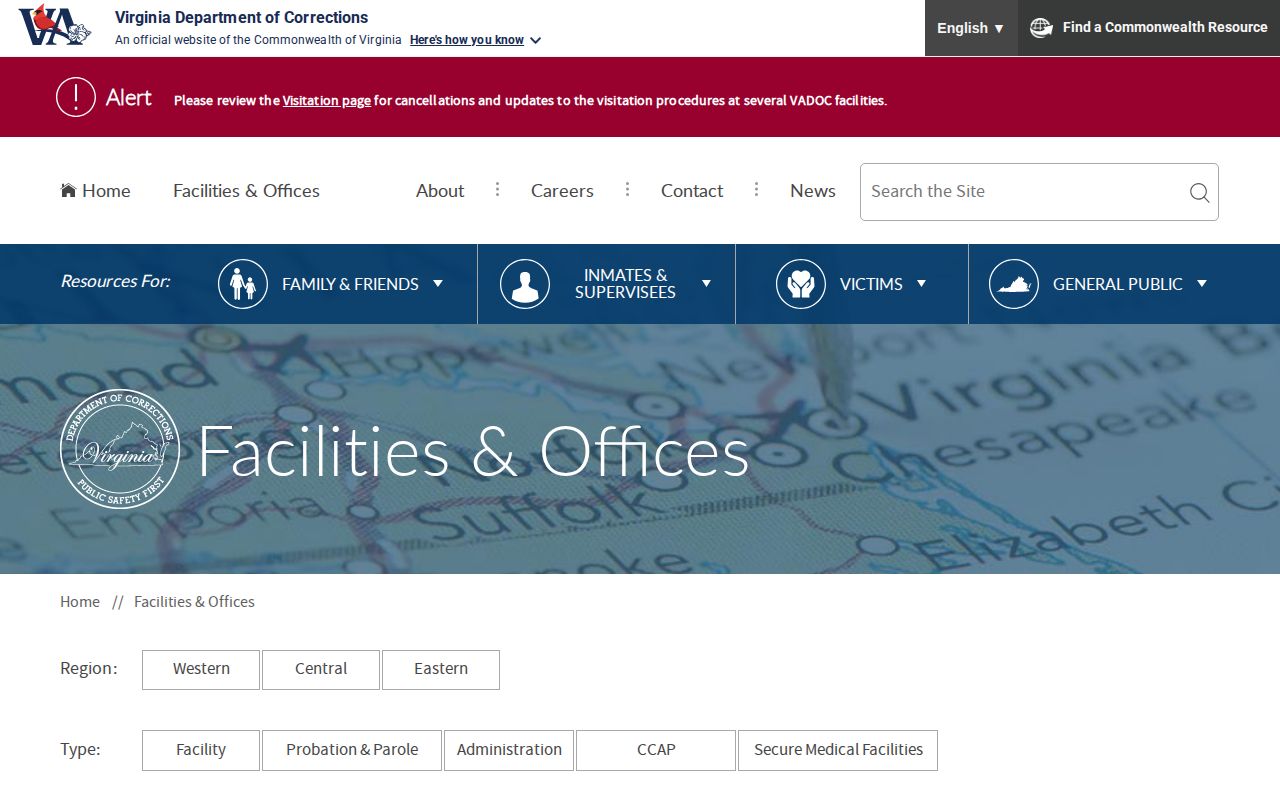
Readers should still recheck the live directory because office leadership and visit instructions can change.
VADOC Probation & Parole District 17
26478 Hillman Highway
Abingdon, VA 24210
276-676-5477
Smyth Suboffice
County directory phone: 276-783-8596
Confirm current address and instructions before visiting.
Requests for a current supervision record should go to the probation and parole chief maintaining it. VADOC's central FOIA office accepts requests at FOIA@vadoc.virginia.gov, 804-963-2953, or P.O. Box 26963, Richmond, VA 23261. Ask for a specific existing record, such as conditions, a discharge document, or an identified status field. Broad files may contain correctional, safety, criminal-history, or personal material that cannot be disclosed.
A former inmate, CCAP probationer, or parolee seeking their own inactive VADOC record uses notarized Form 050_F17 under Operating Procedure 050.6. Board decisions and minutes belong to the Virginia Parole Board, while supervision and facility-release documents belong to VADOC.
District 17 Release Boundaries
District 17 is a state community-corrections office, not a detention facility and not a recent-release feed. Its inclusion in Smyth County's facility map reflects the practical route followed after some state releases. VADOC's probation and parole overview supplies the statewide framework. A former MCTC prisoner may move from institutional custody to District 17 supervision, yet the prison's signed release documents remain the evidence of the physical release.
District 17 is also separate from the Virginia Parole Board. The Board makes decisions in eligible parole cases and publishes delayed monthly decision reports. A grant authorizes the parole process, but certification and facility steps occur before physical release. VADOC administers the resulting supervision. A Board report is not a same-day release list.
- Supervisee
- A person under VADOC community supervision.
- Absconder
- A person alleged to have left supervision without authorization; the term does not itself prove a court finding.
- Capias
- A court-issued order directing that a person be taken into custody.
- PB-15 warrant
- A VADOC supervision warrant used in the violation process.
Note: The supervising officer's instructions and signed conditions control; statewide summaries cannot establish an individual's reporting schedule.
Smyth's Two Supervision Layers
Smyth County has two adult community-supervision channels that are easy to merge by mistake. District 17 handles VADOC probation and parole. Southwest Virginia Community Corrections handles local pretrial or other court-directed functions. A person released on bond through a Smyth court should not be labeled a state parolee merely because both programs use the word supervision.
Read the release or sentencing order first. It names the legal basis and often identifies the responsible program. Then use the corresponding office. If the VADOC locator shows community supervision, District 17 is the likely state route. If the court order names the local program, contact Southwest Virginia Community Corrections instead.
These records are not interchangeable. State supervision material cannot stand in for the local bond or pretrial order, and the local program cannot certify VADOC parole. The distinction also affects where a final discharge or completion record must be requested.
District 17 Warrant Checks
A person may be physically released and later face an alleged violation. VADOC explains that officer PB-15 warrants, court capiases, and Virginia Parole Board warrants can be filed with law enforcement. The VADOC Most Wanted page publishes only selected fugitives and explicitly warns the public not to attempt apprehension.
Absence from that web page proves nothing about warrant status because the list is not comprehensive. A public locator result also may not explain each enforcement step. Use official court records and appropriate law-enforcement or supervision contacts when a current warrant question has a lawful purpose.
A reported violation is not the same as a final revocation. The court or Parole Board process determines the result under the applicable authority. If custody resumes, the receiving jail or VADOC facility record becomes part of the chain.
District 17 Discharge Records
Supervision ends through an official discharge, not merely a quiet locator result. The active district record, signed conditions, court order, and any later discharge document establish the time line. Once a person is fully discharged, the public locator may no longer serve as a historical index.
For past status, request the existing discharge or inactive record through the proper VADOC route. A court file can supply the original sentence and later modification or revocation orders, but it may not contain the district's exact administrative close date. Use both sources when that date matters.
Virginia FOIA does not compel creation of an explanatory report. Name the person, record, approximate time span, and district. Request segregable nonexempt parts if other case material is protected.
The best historical chain usually combines the facility-release packet, the state locator observation made while supervision was active, and the final discharge entry. Each item answers a different question. The packet shows the conditions attached to release, the locator helps identify the active district, and the discharge record shows when VADOC authority ended. Keeping those dates distinct prevents a prison exit date from being mislabeled as the end of probation or parole.
A focused request should identify the DOC number, full name, District 17, and the narrow date range at issue. Ask whether an existing supervision-start, transfer, or discharge document contains the needed fact. Do not ask staff to calculate a new history or resolve a legal dispute in correspondence. If the question turns on the sentence, obtain the court order. If it turns on a Parole Board vote, use the Board's own record. If it turns on the prison exit, seek the facility-release packet.
These divisions also help when the person moved between districts. A District 17 contact may confirm routing while another VADOC office maintains the later active file. The public locator and current facilities directory are time-sensitive, so save the check date and verify any office information before travel.